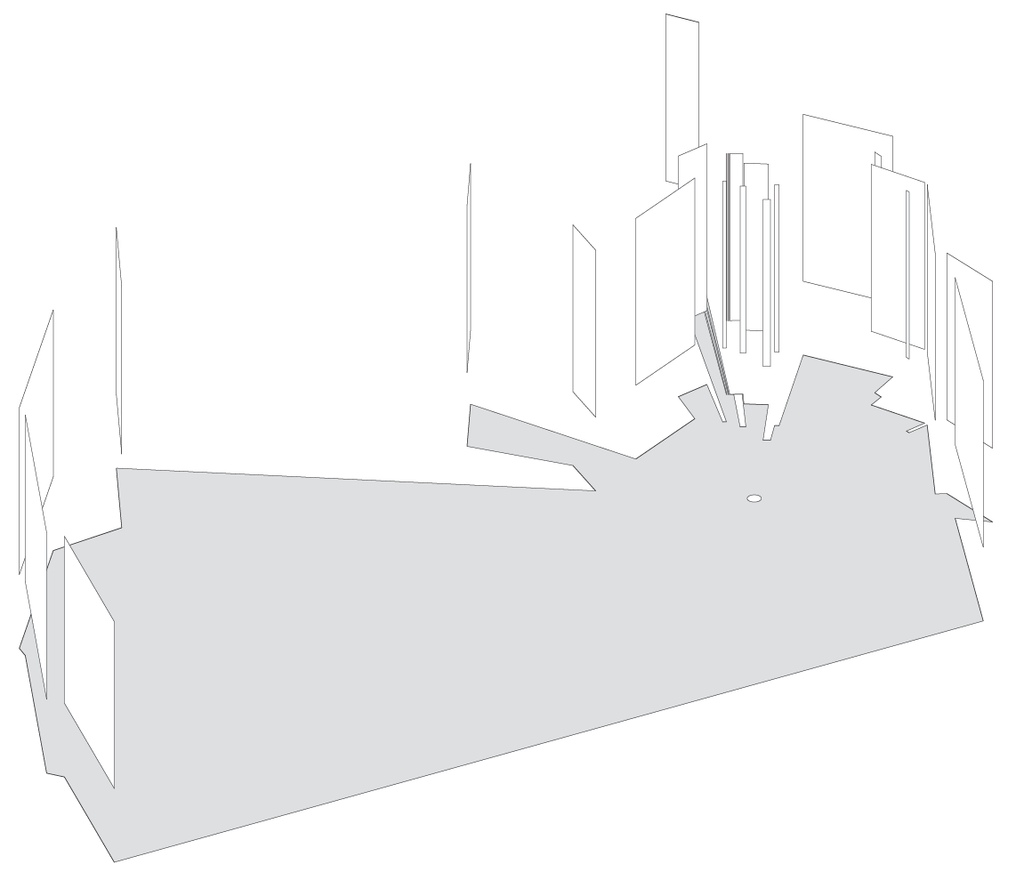
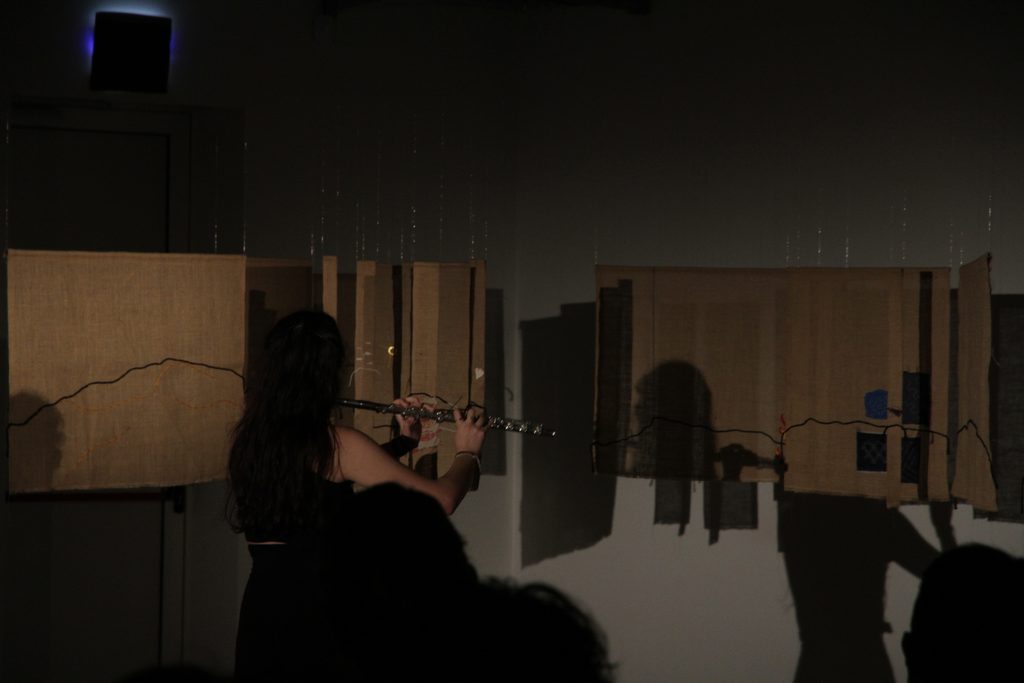
The images show the premiere of Hilling, a notation-installation in textiles which depicts the horizon as it is seen from Valhúsahæð on Seltjarnarnes, Iceland. Mountains are divided between sections (textile hangings) and placed at distances from the stationary performer proportional to their real distances from Valhúsahæð, to create an anamorphosis. The performer considers four visual parameters of the score; the black contour line, the distance, the colour, and the texture. She pairs these as she wishes with the four musical parameters of pitch, intensity, timbre, and speed. No other temporal aspects (such as duration or rhythm) are inferred from the score.
Hilling attempted to reduce the semioticity of notation through minimalism and archetypal abstraction. Those symbols which do appear are very open, and are reduced in discrete meaning through their ability to host several meanings (the idea that at the extreme, something which means everything means nothing).
Can notation be non-semiotic?
This project seeks to expose limitations in the conception of music notation through characterising it as a semiotic system, and to circumvent these limitations through the development of new approaches and perspectives. I use the word teleology here not only for its suggestion that the function or purpose of a notation is inherent in its being, nor that such a function is inevitable, but for the wider implication that semiotics is currently so critical to the conception of notation that to remove it may render notation unrecognisable as such.
The word “notation” here is defined broadly and can refer to both ancient and contemporary representations of music, but the majority is what I would call “conventional” music notation; using symbols which are largely standardised, sometimes locally invented, or both, and most often presented on the page. The word “semiotic” is used to refer to the nature of these symbols as written glyphs, ideograms, etc. for the communication of musical concepts, and more generally to the mediation of thought, i.e. communication through a third party.
A key term is “semioticity”, for rather than starting with the extremes (totally semiotic or totally asemiotic works, which may or may not be irrational), musical works may be seen to be more or less semiotic in comparison to each other. While a semiotic nature of notation is being problematised here, it may not be necessary for this nature to be removed entirely in order to remedy the perceived limitations.
The existence of these conceptual limitations may be felt by an individual in practice, but may also be observed in the development of music notation, particularly in two frictions; that which catalyses new notations from composers, and that which new notations can cause for performers (for example, the question of notating a given idea in one way versus another which may lie at a different point along the spectrum of semioticity).
Potential challenges might include:
- balance between freedom from limitation and compositional specificity/intention (if such a trade-off may be found necessary)
- hesitation from performers to engage with new notations
- the accessibility of new notations (from several perspectives: sensory, bodily, financial, practical/material, etc.)
- barriers in the communication of deviant ideas (e.g. linguistic, ideological, etc.)