The project includes new pieces for live performance where an AI manages the instructions given to the performers. I’ve been making work for about 15 years where human players give cues to each other in order to shape the piece. In doing this, I often use artificial voices, normally generated through pre-recorded text-to-speech. Since 2024 though I have been using LLMs to generate these spoken texts live during a performance, normally in response to spoken input from the performers or other participants. I am using Claude.ai to create browser-based apps to manage the delivery of instructions to performers, managed through scores which mediate the boundaries through which these conversations take place. I’m particularly interested in bureaucracy and institutional constraints at the moment, focusing on the notion of purposeless work and bullshit jobs developed by David Graebner.
There are two pieces currently in the project:
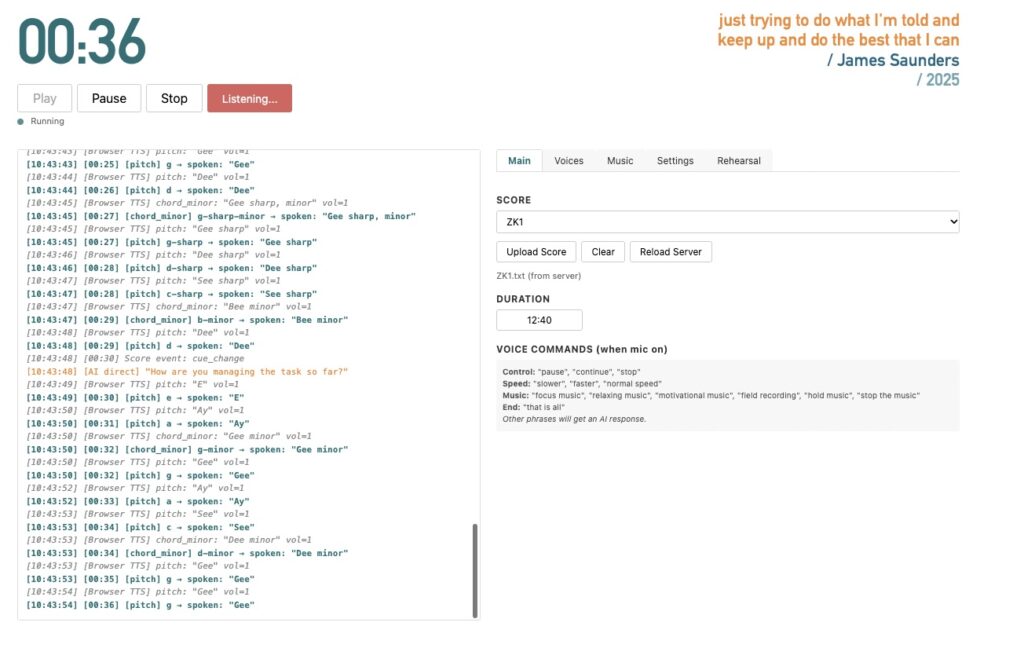
just trying to do what I’m told and keep up and do the best that I can (2025) puts the pianist in an increasingly difficult situation where they are asked to respond to a series of instructions which get progressively harder to follow. The piece reflects on the experience of managing situations where the flow of information and requirement to respond accurately and efficiently becomes overly taxing and impossible to maintain. In these situations, coping strategies might be developed to find a manageable solution or to accept defeat. In the piece, artificial voices give live-generated text instructions that are not known in advance by the pianist, forcing them to respond to each instruction as they hear it. In parallel an AI voice comments on the activities and can be engaged in conversation by the pianist, seeking advice or assisting with the task in different ways. The character and attitude of the AI voice sits somewhere between a benign but largely unhelpful assistant and the intelligence of a telephone automated menu, although it has the potential to transcend both depending on what it is asked. The unforgiving nature of the artificial voices delivering instructions with no accountability or reciprocity with the human player aims to reflect on situations where control is beyond us, but we must still complete the arbitrary tasks we are given.
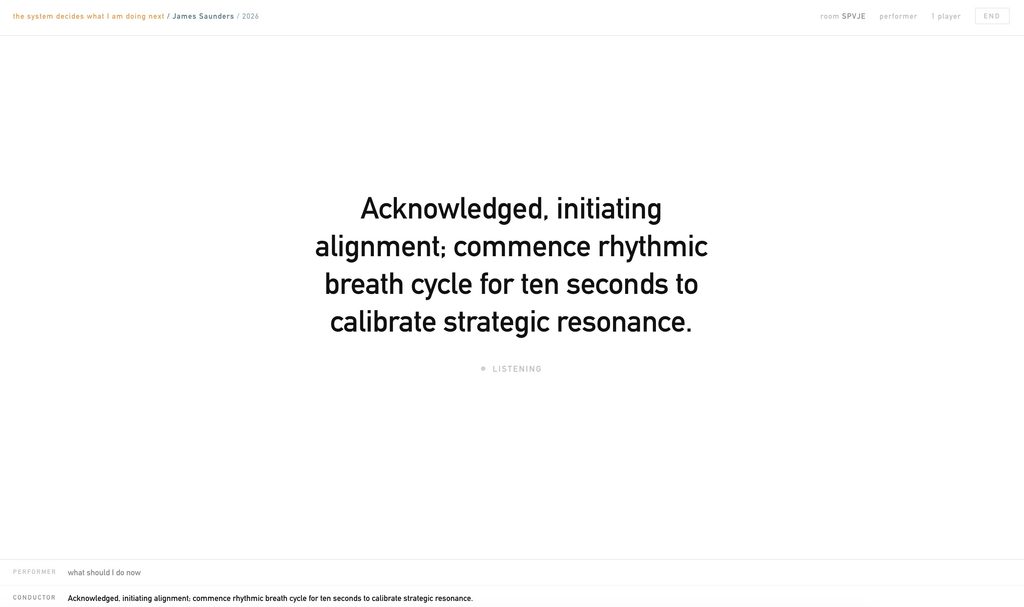
In the second piece, the system decides what I am doing next, an AI gives instructions to a group of people to which they respond as best they can. The instructions are generated live using a large language model to direct the players in predetermined styles (such as poetic, managerial, enthusiastic) and contexts (such as pointless work, music, stillness). Players complete the actions and discuss their progress with the AI, either complying or rebelling against the instructions they are given. The piece explores how we respond to instructions from non-human agents in different contexts, both individually and in groups, and draws on recent developments in human-AI delegation and task allocation.